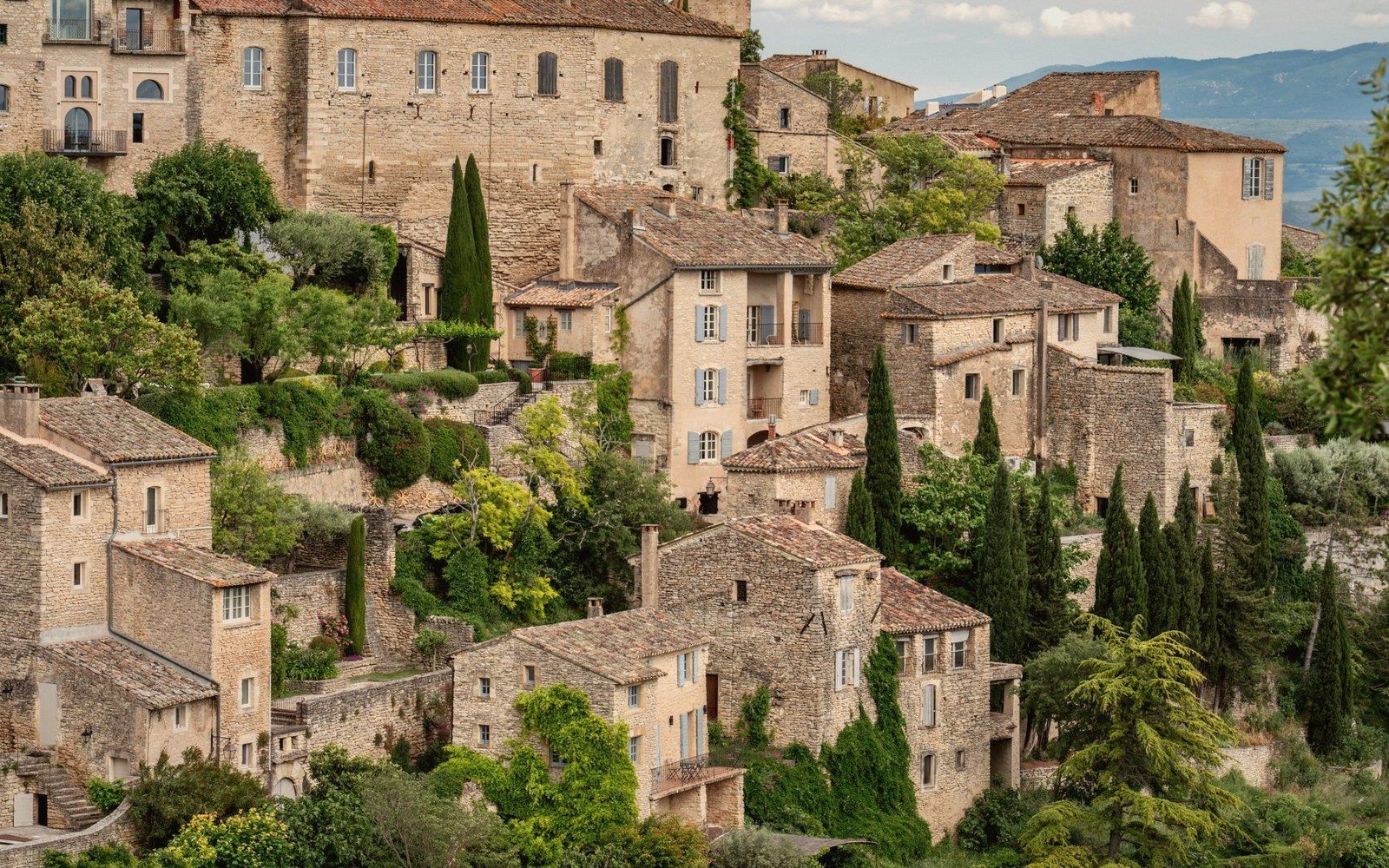
Two villages on opposing spurs of the Petit Luberon, close enough to read each other's rooflines — and far enough apart to have developed quite differently.
Position First, Character Second
Stand at the belvedere in Bonnieux on a clear morning and Lacoste is right there, perhaps two kilometres across the valley, its ruined castle sitting above its houses like a crown that no longer quite fits. From Lacoste's lanes you can return the favour, looking east across the same shallow bowl to Bonnieux's terraced bulk climbing toward the cedar forest on the plateau above. The two villages have been watching each other for centuries, which makes comparing them something more than a parlour game.
Both sit on spurs of the Petit Luberon — the lower, more heavily populated of the massif's two ridges — where the plateau pushes fingers of limestone northward toward the Calavon valley. This spur geography is everything. A Luberon village is not merely situated in a landscape; it is an extension of it. The spur determines orientation, determines which wind hits which wall, determines whether the village gets the first light or the last. Bonnieux is on the larger, higher spur. Lacoste is on the smaller one, slightly lower, slightly more exposed to the open sky above the valley.
Scale, Height and the Plateau Above
Bonnieux is emphatically the bigger of the two, not in sprawl but in vertical ambition. The village climbs steeply through several distinct tiers: a lower bourg of nineteenth-century expansion, then the older medieval core winding upward, then the twelfth-century upper church at the summit, used now only for the occasional formal ceremony while its replacement handles daily worship below. The ascent rewards you: from the terrace beside the upper church the view runs west toward Gordes, north across the Calavon corridor to the Vaucluse plateau, and east toward Apt. What strikes you is how much of the massif you can read from up here — ridge behind ridge.
The cedar forest above Bonnieux is part of the village's identity in a way that has no equivalent at Lacoste. Planted deliberately in the nineteenth century on the Petit Luberon plateau, it sits directly behind the upper village and gives Bonnieux a substantial hinterland — shaded walks, cool air in summer, a sense of depth to the land that ends the village at the back. Lacoste has the plateau too, of course, but the approach from its side is more abrupt; the village does not lean into the forest the way Bonnieux does.
Lacoste is compact in a way that reads almost as concentrated. There are fewer streets, fewer residents, fewer restaurants. The village feels as though it was arranged for the castle and has not quite reorganised itself since the castle fell into ruin. The Marquis de Sade held the château here — long enough and scandalously enough to ensure Lacoste carries that association wherever it goes. The castle has since passed through various hands and seen substantial restoration work; it is a presence on the skyline rather than an open monument, and that ambiguity suits the village.
What the Valley Between Them Says
The floor of the valley they overlook is worked agricultural land — vines, cherries, some lavender on the higher edges — and the Calavon corridor running along the northern foot of the massif is the real artery of movement. Neither Bonnieux nor Lacoste sits on it. Both sit above it, which is precisely the point: these villages were built for defence and altitude, not for easy passage. The road through the valley is a convenience added later. The villages belong to the ridge.
This shared elevation gives them something in common that their differences obscure. Both have the particular quality of perched Luberon villages in that the surrounding countryside is always present — not glimpsed between buildings but fully visible, the valley air moving through freely, the light changing across the limestone in ways you register almost before you notice you are doing it. That quality is harder to describe than to feel, and it is part of why people return.
The difference is one of weight and rhythm. Bonnieux carries more — more tiers, more history in stone, more of a working village feel even now. Lacoste is lighter, quieter, more self-contained, a village that seems to wear its famous past with a certain detachment. Looking across at each other from their respective spurs, they make a useful pair: not rivals, not twins, but neighbours who have been shaped by the same massif and arrived at quite different characters because of where, exactly, they chose to stand on it.