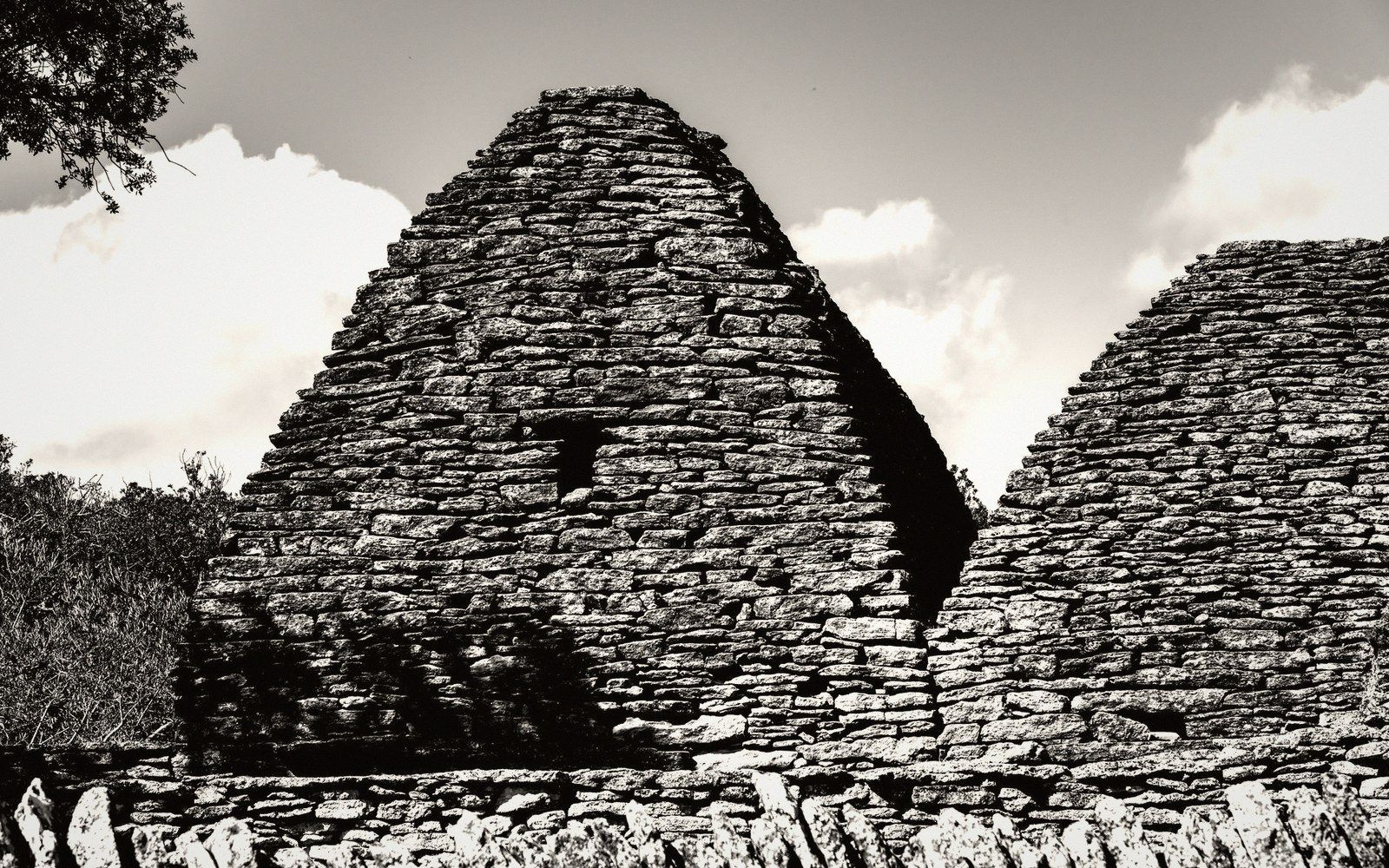
A hut built without mortar, a landscape built without waste
A borie (dry-stone corbelled hut) is not a ruin in the ordinary sense. It was built to last, and it did — some stand after three centuries with no mortar, no timber, no fixing agent beyond the weight and angle of the stones themselves. Flat limestone slabs are laid in overlapping courses that tighten as they rise, each ring cantilevered slightly inward until the final capstone closes the dome. The principle is corbelling: gravity does the work that cement would do elsewhere.
They survive in their thousands across the Luberon, most densely on the Petit Luberon plateau and around Gordes, where the ground produces limestone in inconvenient abundance. That abundance is the point. Clearing fields for cultivation or pasture meant moving stone; moving stone meant you needed somewhere to put it. Bories are the answer — storage, shelter for a shepherd or a tool, sometimes a pen for animals — built from the exact material you were trying to remove. The landscape made them inevitable.
Their concentration also maps transhumance routes, the seasonal movement of sheep between lowland winter pasture and upland summer grazing. Shepherds needed overnight shelter and somewhere to work from; a borie on a high plateau was exactly right. Some clusters, including the famous Village des Bories outside Gordes, show evidence of occupation stretching back to the seventeenth century, though the building tradition is older.
What they are not is mysterious or prehistoric, though both claims circulate freely. They were built by farmers and shepherds who needed practical structures from the material at hand. Their beauty is a by-product of that practicality — and the fact that the Luberon plateau kept producing limestone long after those farmers were gone.
