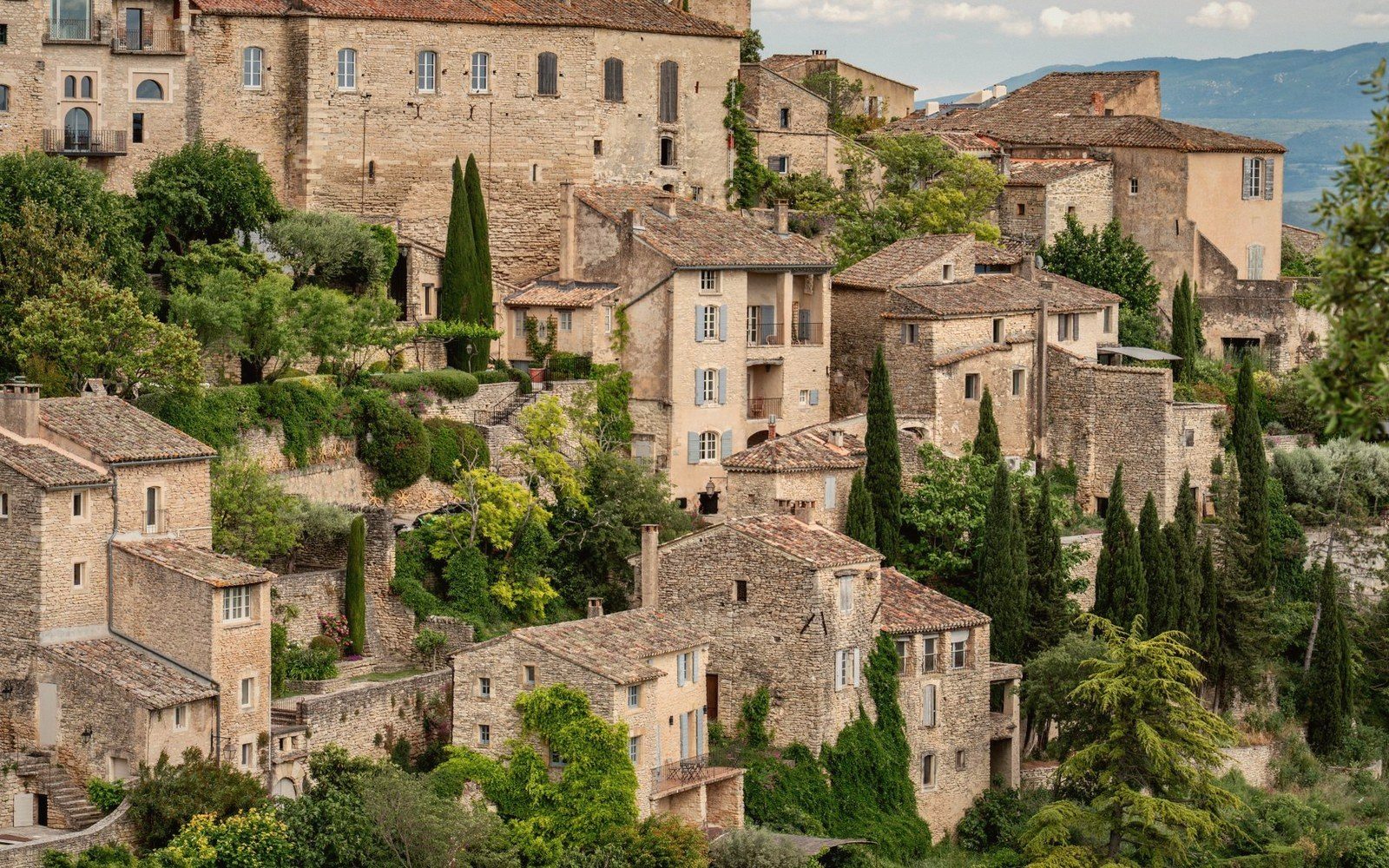
The most photographed village in the Luberon earns its reputation on a south-facing lens — but the village itself looks the other way.
A Wall, Not a Balcony
Gordes sits on the edge of the Monts de Vaucluse — not the Luberon massif itself, despite how it feels when you drive up through the gorge — stacked on a limestone bluff that drops steeply toward the Calavon valley below. The photographs that fill every Provence calendar are taken from the north, looking south into the sun, which is exactly the direction the village does not face. The village itself faces north and northwest, into the Vaucluse plateau and, in winter, directly into whatever the mistral decides to send.
That aspect is the key to understanding what Gordes actually is. It is not a sun-trap. The terraces and ramparts catch the afternoon light in summer well enough, but the stone here stays cooler longer than in the villages on the southern flank. On a clear January morning, shadow sits on the lower lanes until mid-morning and never really leaves the tightest alleys. The golden limestone — the same tawny calcaire that makes every photograph glow — absorbs far less warmth here than it would on a south-facing slope, and it gives none back by nightfall. Winters are cold and unambiguous.
What the Stone Shows
The building material is what the geology allows: pale, close-grained limestone from the massif itself, harder and greyer than the warmer stone you find around Bonnieux or Ménerbes. Centuries of weathering have given the walls a faint blue-grey cast in certain light, especially on overcast days in March, when the village can look almost Nordic. This is not a complaint — it is the source of the peculiar austerity that sets Gordes apart from the ochre warmth of Roussillon ten kilometres east.
The dry-stone construction throughout the surrounding plateau reflects the same logic: tight, compact, built for insulation against cold as much as against heat. The bories — corbelled dry-stone huts — that cluster most densely just south of the village were almost certainly used as much for shelter from cold and wind as for summer shade. The massif does not particularly care about your comfort in either direction.
Slower to Start, Longer to Finish
The north-facing aspect has a direct consequence for anything that grows here. The altitude and exposure of the village itself means that spring arrives noticeably later than on the southern flank — almond blossom here follows what you see around Lourmarin or Cucuron by a week or more, sometimes two. The market gardens that clung to the terraces below the village in earlier centuries were always marginal, working against the slope rather than with it.
What this means for anyone spending time in Gordes — not just photographing it from the valley — is a particular quality of light and temperature that the images cannot encode. In early morning, even in June, there is a coolness to the upper village that reads as genuine, as though the stone has kept something back from the night before. By mid-afternoon in summer, the south-facing terraces warm properly, but the lanes themselves stay shadowed and workable.
In high summer that coolness is the village's gift to its residents. In February it is simply the bill. The wind comes in hard off the plateau and the narrow streets do nothing to slow it — they funnel it. The calendar-cover shot, taken from the valley floor on a brilliant September afternoon, shows the village at its most composed. What it does not show is the direction the village is looking, or what it sees.