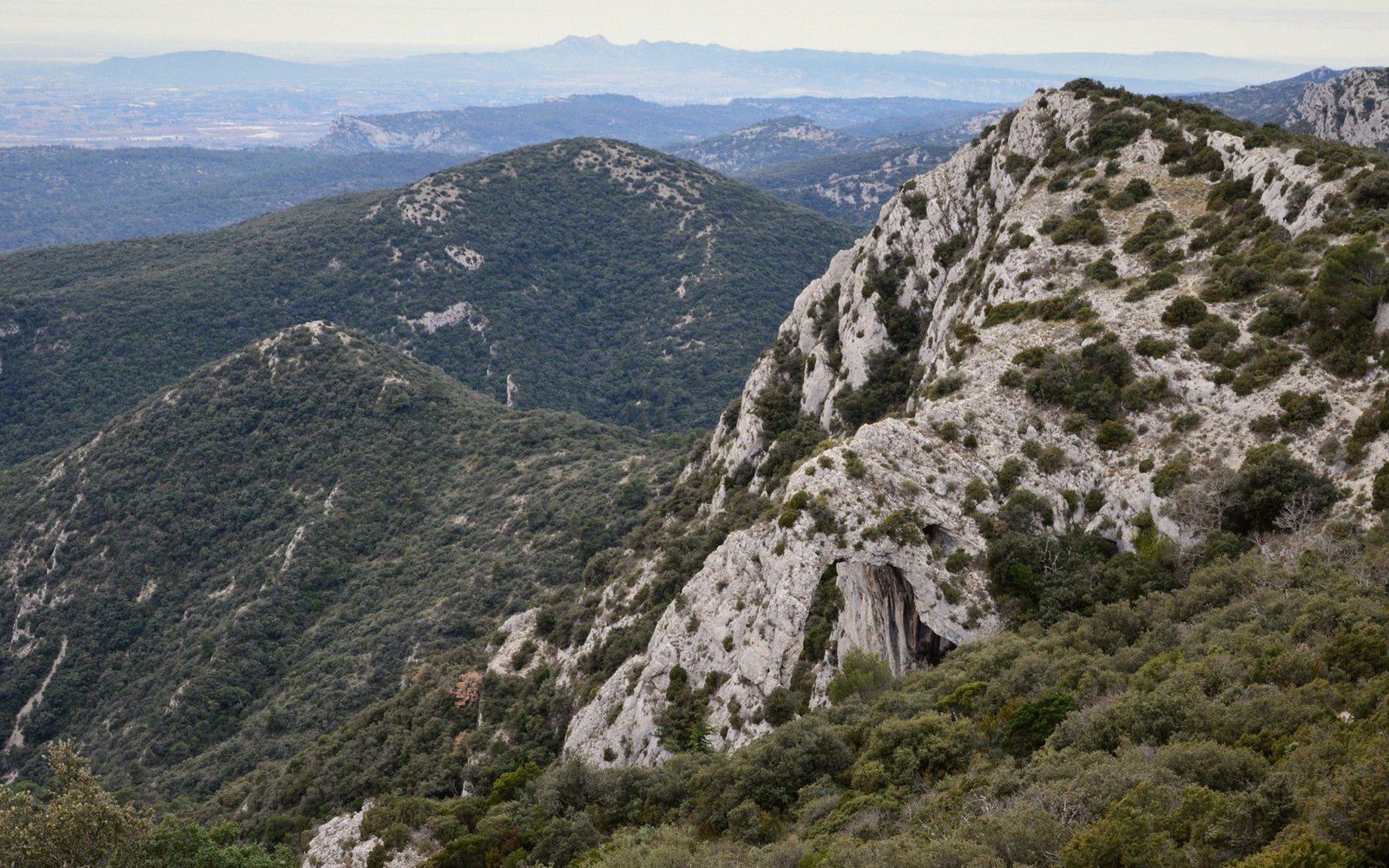
The appellation is named after the massif but does not follow it faithfully — understanding the gap between the two tells you most of what you need to know about these wines.
Geography First: Where the Boundaries Fall
The Luberon Appellation d'Origine Contrôlée — AOC, the French designation for controlled wine-growing zones — covers vines in the Vaucluse department on both flanks of the massif and out onto the alluvial plain between the southern foot of the range and the Durance river. It is not a single-landscape appellation. From the high limestone garrigue above Bonnieux to the flat, fruit-growing plain below Pertuis, the elevation change is substantial, the soils shift from thin calcareous rubble to deep alluvial loam, and the exposure swings from cold north-facing slopes to sheltered, sun-retaining southern terraces. The appellation bundles all of this together under one name.
The official territory takes in 36 communes, all in the Vaucluse, stretching roughly from Cavaillon in the west to the département's eastern edge just short of Manosque — a corridor that follows the massif itself but then fans out considerably to the south. To the north, the boundary is essentially the Calavon valley, the east–west corridor that runs along the foot of the massif past Apt before turning toward Forcalquier. Beyond that northern edge, you cross out of Luberon AOC territory and into either Ventoux, which covers the slopes of Mont Ventoux far to the northwest, or the broader Côtes du Luberon designation, which is another name for the same appellation used in an earlier regulatory period and should not be confused with a separate zone. The renaming from Côtes du Luberon to simply Luberon came in 2009, two decades after the appellation was confirmed at full AOC status in 1988, graduating from VDQS — Vin Délimité de Qualité Supérieure, a now-abolished intermediate French quality tier.
What this means on the ground is that the wines arriving at your glass with a Luberon label could have grown on a bone-dry limestone plateau at over five hundred metres, or on warm, productive valley-floor soils closer to sea level. The altitude band is genuinely wide. The highest vineyards sit in the Petit Luberon's skirts and on its northern shoulder at elevations that push past five hundred metres; the lowest, on the Durance plain near Pertuis and La Tour d'Aigues, barely clear two hundred. This is a larger vertical range than most drinkers associate with southern French wine, and it matters.
What Grows There, and Why the Mix Is Unusual
The permitted varieties in Luberon AOC are recognisably southern French — Grenache, Syrah, Mourvèdre, Carignan and Cinsault for reds and rosés; Grenache Blanc, Clairette, Bourboulenc, Roussanne, Marsanne and Ugni Blanc for whites — but the appellation's unusual altitude and its exposure to cold air, particularly on the north flank, mean that wines from the higher sites ripen later and retain acidity at levels you would not expect from a Côtes du Rhône produced thirty kilometres to the north, at lower elevation.
The Luberon's position is worth being precise about. The massif runs broadly east–west, which creates two genuinely different climates on its flanks. The north face catches less sun and is exposed to the mistral and cold air draining down from the plateau; the south face is sheltered from the mistral, angled toward the Mediterranean sun, and produces wine with a riper, more generous character. Rosé, which accounts for a large portion of total Luberon production, comes predominantly from the south-facing and valley-floor sites where Grenache and Cinsault ripen evenly and produce the pale, dry style that the regional market and export trade both favour. Syrah appears in reds from both flanks, but tends to perform better on the cooler north-facing sites, where the slower ripening preserves the variety's peppery aromatic quality. Mourvèdre, which needs warmth to avoid a hard, reductive character, finds its most comfortable positions on the southern flank and the Durance plain.
The white wines are less widely known than the reds and rosés but deserve attention. Roussanne in particular does well on the limestone soils of the higher northern sites, producing wines with a floral and herbal complexity quite different from the fatter, more alcoholic whites of the southern Rhône. Clairette and Bourboulenc contribute freshness and length. Ugni Blanc, which is otherwise known almost entirely as the base for Cognac distillation, is present in older Luberon plantings and gives neutral volume without much personality — an honest worker rather than a star. The shift in recent decades has been toward Roussanne and Marsanne plantings at the expense of Ugni Blanc in serious white production, a change made possible by regulatory flexibility within the appellation's blending rules.
How to Read a Luberon Label Without Being Misled
The confusion with neighbouring appellations — particularly Ventoux and Côtes du Rhône — arises partly because the Luberon sits at a kind of crossroads of southern French wine geography. The Ventoux AOC is to the northwest, covering the southern and eastern slopes of Mont Ventoux; Côtes du Rhône covers a vast zone to the northwest and west; the Pierrevert AOC edges the Luberon's eastern territory near Manosque. None of these is the Luberon, and none should be treated as equivalent. They share grape varieties and the general Provençal climate, but the massif itself — the altitude, the limestone, the mistral-shadowing — gives Luberon wines a character that the valley-floor Côtes du Rhône does not replicate.
What you can reasonably expect from a bottle carrying the Luberon AOC, setting aside the enormous variation within the appellation, is a wine made in a drier, more structured style than the popular image of southern French wine suggests. The altitude keeps alcohol levels generally moderate by southern French standards. The limestone soils produce reds and rosés with a mineral edge and reasonable acidity. The best whites show a herbaceous and stony quality that reads as distinctly Provençal without the weightiness of, say, a Châteauneuf-du-Pape blanc.
What you cannot infer from the label alone is whether the grapes came from the exposed upper garrigue or the warm, productive plain. Unlike Burgundy, the Luberon AOC has no formal hierarchy of vineyard sites, no premier or grand cru classifications. Production is dominated by cooperatives — particularly the large cave coopérative (cooperative cellar) at Bonnieux and the cooperative at Lourmarin — alongside a growing number of independent domaines. The cooperatives handle the majority of the appellation's volume and maintain a reliable, if rarely exciting, standard. The independent estates tend to work smaller parcels at specific altitudes and exposures, and the best of them make wines that repay some attention.
The two sides of the massif taste different in ways that a single appellation name cannot communicate, which is one reason that estate-labelled wines from declared single communes are worth seeking out — at least you know which flank and which altitude you are working with. A wine from a domaine above Bonnieux or Lacoste, grown on the colder northern shoulder, will behave differently at the table from one grown on the Pertuis plain some twenty-five kilometres to the south. Both are Luberon AOC. The name covers the whole range; your palate has to do the rest of the work.