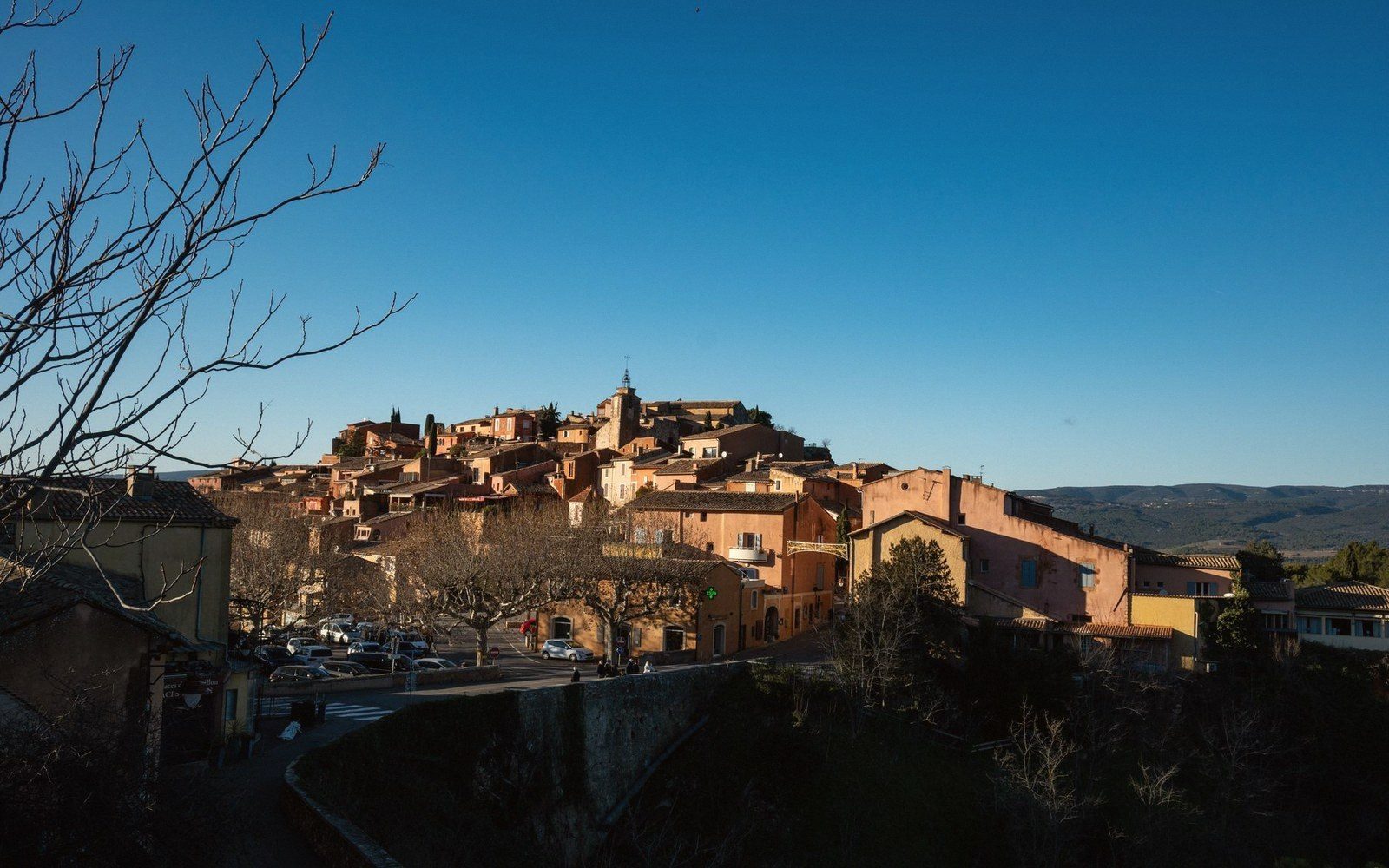
The cold months strip the massif back to limestone and light — and what remains is more itself than anything August offers.
What Goes Away, and Why That Matters
Most of what people come to the Luberon for in summer is not the Luberon. It is the idea of the Luberon — the dappled terrasse lunches, the painted shutters, the lavender fields that are, in any case, long over by the time most visitors arrive. In February, the idea evaporates. The terrasses are stacked and chained. The lavender is grey sticks. The lanes in Gordes and Bonnieux are genuinely, almost shockingly empty. And what is left, once all of that falls away, turns out to be the actual place.
The light is the first revelation. In August the sun is directly overhead much of the day, flattening everything, bleaching the ochres and burning out the detail in the limestone. In February the sun stays low from east to west, and it arrives at an angle that rakes across every surface — across the tiled roofs of Bonnieux, across the borie walls scattered through the garrigue, across the white cliff faces above Buoux where the rock is folded and cracked and genuinely sculptural. The shadows are long by mid-morning and blue by mid-afternoon. Photographers who understand light and carry their own warm clothes tend to come in winter.
The cold is real. The mistral, the dry northerly wind that tears down the Rhône corridor and accelerates through every gap in the massif, can make a February day in the Calavon valley feel punishing — not wet-cold but a cold that finds the back of your neck and stays there. Villages on the south flank fare better. Lourmarin, sitting in the one natural passage through the massif, catches a different kind of weather: milder than anywhere on the plateau, sometimes warm enough at noon to eat outside in a coat. But the plateau itself, and anything above four hundred metres, will remind you that the Luberon is a real massif with a real climate, not a Mediterranean garden.
That reminder is not a problem. It is the point.
The Villages Without Their Summer Selves
Arrive in Gordes on a February morning and you will park immediately, without ceremony, in the large car park that in July is full before nine. Walk up into the village. The lanes that become bottlenecks of foreign voices in summer are narrow again — the narrowness designed into them when they were defensive passages, not scenic corridors. You can see the architecture for what it is: the tight fitting of dry stone, the corbelled doorways, the way the houses build on each other up the slope so that the roof of one is the terrace of the next. None of this is invisible in August, but in August you are looking at it around someone's shoulder.
The boulangeries and one or two cafés remain open through winter in most villages of any size — Lourmarin, Apt, Cucuron, Bonnieux — though in the smaller satellites things close and the visitor has to accept some self-sufficiency. Come with provisions, or drive to Apt, which runs as a working market town regardless of season and whose weekly market draws the valley year-round. The truffle season, running roughly through winter, gives Apt and its surrounding villages an economic activity that has nothing to do with tourism and makes the town feel most like itself from roughly late December to mid-March — merchants, farmers, a certain quiet purposefulness that August, for all its income, does not quite produce.
Roussillon in winter is a particular case. The ochre geology is unchanged, the colour does not hibernate, and with the coach parties absent the village sits on its red-clay plateau looking exactly as extraordinary as the geological accident that made it deserves. The slant winter light on the exposed ochre faces — the cut cliffs, the crumbling pinnacles — is arguably more vivid than summer's bleached noon. A short walk along the sentier des ocres, the ochre path, on a cold clear February morning puts you inside colour rather than observing it from a dusty road. Nobody else is in front of you.
The rhythm of village life in winter is not secretive, but it is quieter and not arranged for your benefit, which is a different thing. The pharmacie and the cave coopérative — the village wine cooperative — open and close on schedules that serve residents. The weekly markets continue, but they are practical markets, heavier on root vegetables, cheese, preserved meats and hardware than on lavender sachets. If you speak some French, or are willing to try, February is when the massif will actually talk back.
The Landscape Doing What It Does
The agricultural year moves in winter too, but slowly, and what it produces are the kinds of images that ten million summer photographs have never quite managed to capture. The bare vine rows are the clearest example. Strip a Luberon vineyard of its leaves and canopy and you can see the full geology of the slope — the limestone scree on the higher parcels of the Petit Luberon, the red-clay soils around Ansouis and Pertuis, the alluvial flatness down toward the Durance. The vines themselves in winter are knotted, pruned hard, grey-brown, ancient-looking even on young plants. They grow in rows that follow the contour lines with a precision that no summer photograph, crowded with green, can reveal in quite the same way. Drive the road between Lourmarin and Cucuron in early February and the vineyard geometry of the lower southern flank is completely legible: who owns which parcel, where one appellation's character ends and another begins, what the growers are deciding about their soils.
The garrigue — the low scrubby aromatic vegetation of limestone hillsides — is still present in winter, just less insistent. The cistus, thyme, rosemary and kermes oak stay evergreen or semi-green, and on a warm winter afternoon their smell is closer to the soil's own smell than the blowsy, almost artificial perfume they produce in July heat. Walk the Petit Luberon plateau in February and the cedar forest planted above Bonnieux in the nineteenth century is at its densest and greenest, the cedar smell clean and resinous in cold air, the path underfoot a mat of fallen needles. The plateau is open to walkers outside the summer fire-closure period, and on a dry February day the ridge gives views south to the Sainte-Victoire and north to Mont Ventoux that the summer haze routinely obliterates.
The Calavon valley floor is a different winter landscape — flat, agricultural, the fields turned and dormant, the orchards pruned to clean silhouettes. The cherries and apricots that make the Apt basin famous are bare branching structures in February, and the irrigation channels that feed them are mostly dry. What you are looking at is the skeleton of a productive landscape, and it is honest in a way that the laden summer orchards, beautiful as they are, cannot quite be. The river itself, the Calavon, runs higher and faster in winter than the thin trickle summer visitors occasionally find surprising — it is a real watercourse in the wet season, carrying snowmelt from the Apt hinterland down toward the Coulon confluence.
What to Actually Do With It
February in the Luberon rewards a certain disposition: a willingness to walk at the massif's pace rather than the summer visitor's pace, to eat well at lunch when the light is best and the good simple restaurants have tables and time, to spend an afternoon reading in a house where the shutters are cracked open on a south-facing window. It also rewards walking.
The ridge and valley paths that become fire-closed and overcrowded in summer are open and largely empty in February. The sentier des ocres at Roussillon, the Colorado Provençal circuit at Rustrel, the approach to Fort de Buoux through the gorge — all of them deliver in cold weather a quality of solitude that, in this part of Provence, has become genuinely rare. The climbers who work the limestone faces above Buoux and Oppedette tend to prefer the dry cold days of late winter for friction; you will sometimes share a path with them and no one else.
None of this is to pretend that February is the same experience as July. It is not. There is no swimming, no lavender, no rosé at six in the evening on a warm stone terrace. Some things are closed, some villages barely staffed, and the cold snap that settles in when the mistral comes through for three days is not charming — it is just cold. Anyone who tells you the Luberon in winter is a secret paradise is doing the thing this guide tries not to do.
But the landscape does not need tourist-season conditions to be itself. The limestone is the same limestone in every month. The light on the ochre cliffs at Roussillon in February is the colour the place actually is, without the crowds standing between you and it. The empty lane in Gordes on a Tuesday morning in February is the lane as built, not the lane as managed. What the cold months offer is the massif without its summer role, which turns out to be a great deal more than a consolation prize.