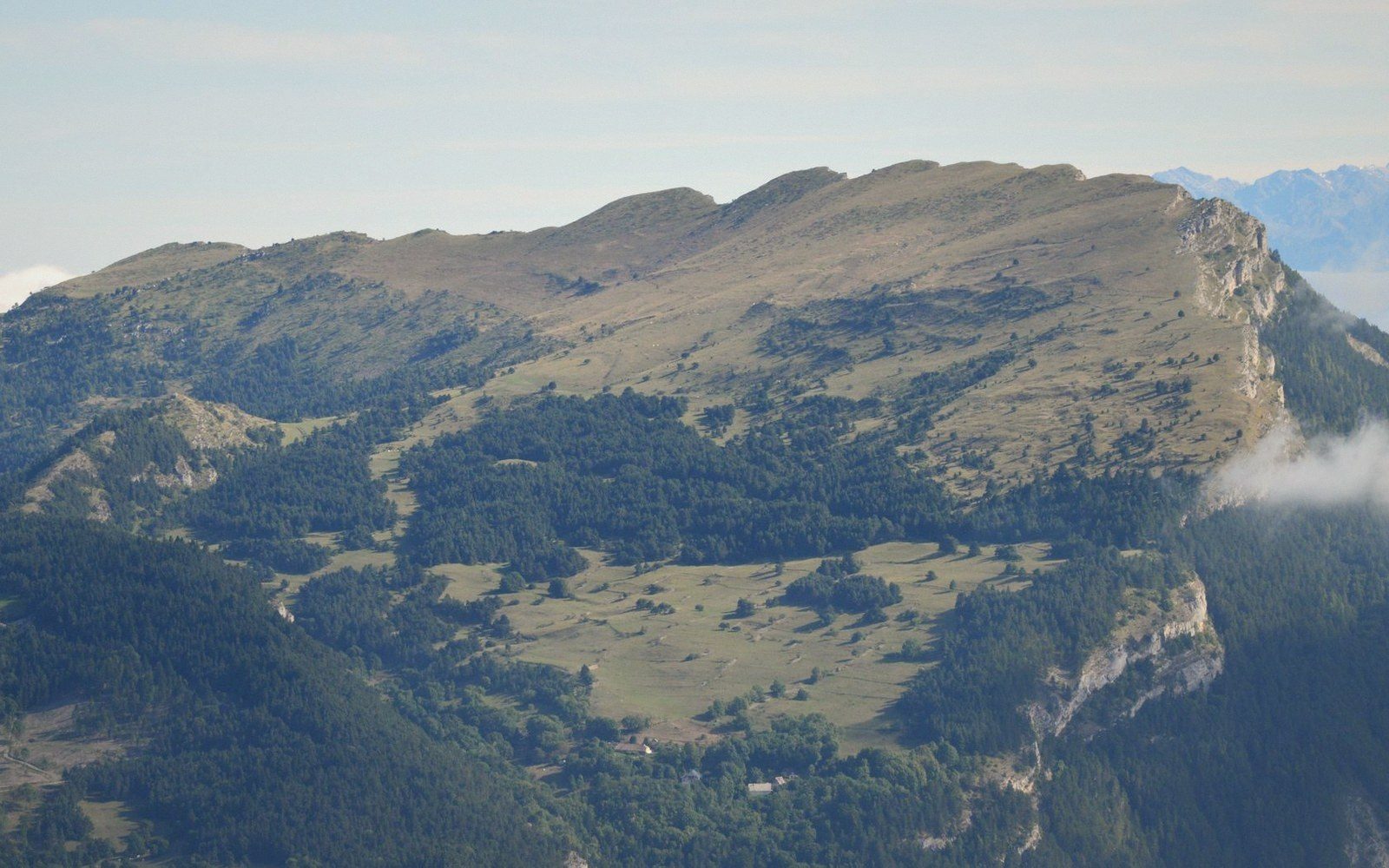
The plateau of the Petit Luberon is not a bare summit but a dense, complex ceiling — and what grows there tells you exactly where the land gave up on people, or people gave up on the land.
A Plateau, Not a Peak
Spend long enough looking up at the Petit Luberon from the valley floor and you might assume the ridge is exposed — wind-blasted, thin-soiled, the kind of limestone crest that resists everything. The Grand Luberon does work that way: Mourre Nègre at 1,125 metres is treeless and scoured, a bald back turned to the sky. The Petit Luberon is different. Its ridge tops out well below a thousand metres, and that lower elevation, combined with the orientation of the plateau and the accumulated centuries of planting, means the high ground here is covered rather than exposed. Cedar, pubescent oak, box, pine, garrigue — the tangle of low aromatic scrub that is the default vegetation of the Provençal limestone — all of it pressing up to the plateau and in some places claiming it entirely.
The most legible chapter of this planting story sits above Bonnieux. The cedar forest there — Atlas cedar, Cedrus atlantica, brought from North Africa — was introduced in the nineteenth century as part of a national reforestation effort designed to stabilise eroded hillsides and slow the catastrophic soil loss that followed generations of overgrazing and fuel-cutting. The trees are not indigenous, but they have been here long enough to feel inevitable, and the forest they form is dense and slightly disorienting, the canopy closing out the sun and the floor going quiet underfoot. That forest was planted on purpose, and the purpose was remedial: the hillside was exhausted.
The Edge Where Cultivation Gave Out
What the cedar planting records, and what the broader character of the plateau confirms, is an economic frontier. On the flanks of the Petit Luberon — north and south — cultivation climbed high in earlier centuries. The terraces are still there, the dry-stone retaining walls holding soil that no longer gets worked, the remnants of kitchen gardens and modest vine plots carved into ground that was always marginal. Those terraces are not a sign of abundance; they are a sign of pressure, of a population that could not afford to waste slope. When that pressure eased — through rural depopulation, through the drift toward the valley floor, through the mechanisation that made steep hand-worked land uncompetitive — cultivation retreated downhill and the plateau reasserted itself.
The line where farmland becomes impossible to work is not dramatic. It does not announce itself. You walk up through a village, through terraced gardens going to seed, past the last olive trees tilting over broken walls, and then the path enters garrigue and the domesticated world is simply behind you. The soil has thinned to almost nothing over the limestone. The bories — corbelled dry-stone shelters used by shepherds and farm workers across the plateau — mark the zone where people worked without ever quite settling, moving with animals across ground that could be grazed but not reliably planted.
The garrigue itself is not uniform. Kermes oak, thyme, lavender, rosemary, rock rose — the composition shifts with the aspect, the soil depth, the degree of past disturbance. On the south-facing edge of the plateau, where the Petit Luberon drops toward the Lourmarin corridor and the villages of the southern flank, the vegetation is more open and more aromatic; the sun has it directly. On the north side, facing the Calavon valley, the cover is denser and the understorey darker. Between those two edges, on the plateau proper, the cedar and oak forest occupies what was once the commons — the shared rough grazing that sustained whole village economies and that is now, in the absence of those economies, simply forest closing in.
What It Tells You
Walk the Petit Luberon ridge and the planting history becomes a kind of map of economic failure and natural recovery running simultaneously. The cedar forest is managed; the garrigue is not. The terraces are silent. The bories stand without their shepherds. What has grown up in the gap between the productive past and the recreational present is dense, impenetrable in places, alive with birds and insects, and genuinely wild in a way that the valley floor below, with its cherry orchards and market gardens, has not been for a long time.
The plateau did not return to wilderness accidentally. It returned because the economics of working it collapsed, and then, in the cedar forest, because someone decided that a planted ceiling was better than an eroded one. Both decisions left marks. Both are still legible, if you know what you are looking for.